Ideas and Their Inferiors
The nature of ideas or concepts; universal ideas and their inferiors; the five predicables; and the special status of transcendental ideas that exceed the ordinary limits of universality.
The concept of being is the most universal of all concepts — a transcendental idea that applies to everything that is or can be, exceeding the limits of any single category. Universal ideas have their inferiors: the beings or kinds of being that fall under them. The five Predicables (Species, Genus, Specific Difference, Property, Accident) describe the modes in which a universal idea is predicable of its inferiors. Transcendental ideas (being, unity, truth, goodness) differ from categorical universals in exceeding the scope of any single category and admitting of neither genus nor species in the strict sense. The analogy of being — the mode in which one concept applies to the infinite diversity of real things in proportionally related but not identical senses — is the governing concept for all ontological analysis.
Book First — Being
This Book studies the meaning of the term being, discusses the idea or concept of being, investigates the manner in which the idea applies to things, and discerns the fundamental principles involved in the idea. Further, the Book discusses the object of the idea being (that is, being itself) in its primary determinations as real or logical, actual or potential, as essence and existence. The Book is divided into two Chapters:
Chapter I. The Idea of Being
Chapter II. Primary Determinations of Being
Chapter I — The Idea of Being
This Chapter studies the meaning of the term and concept being. It investigates the manner in which being is predicated of its inferiors, that is, the way in which the idea being is applied to, or affirmed of, things. The Chapter is divided into two Articles:
Article 1. Ideas and Their Inferiors
Article 2. The Idea of Being and Its Inferiors
Article 1. Ideas and Their Inferiors
a) Ideas; b) Universal Ideas; c) Inferiors of Ideas; d) Transcendental Ideas
a) Ideas
An idea (called also concept or notion) is the essential presence of a thing in the mind; rather, it is the re-presence or representation in the intellect of the essence of a thing. Now, the essence of a thing is what constitutes the thing in its fundamental reality as such a thing; essence makes the thing precisely what it is in its specific kind. That, for example, which makes a man a man is the essence of man, that is, the essence of human being. It is not his age, nor his sex, nor his nationality, nor his fatness, nor his learning, nor his innocence of crime, nor his standing in the community. That which makes him a man is his man-ness, his human-ness; it is the essence man, arid nothing else. Again, that which makes white paint white is not the substance of paint, nor its thickness or thinness or chemical composition; it is its whiteness; it is the essence of being white, and nothing else. All this may seem so evident as to make discussion about it merely silly. But the discussion is not silly; it is rather subtle, and vastly important. In things of the mind, obviousness is often the cloak of what is most profound.
An idea, then, is an essence present in the mind. Of course, an essence is, first and foremost, present in the thing which it constitutes. It is re-present (it is there by representation) in the mind which knows that thing. An essence makes a thing (substantial or accidental) precisely the specific kind of thing that it is. Everything has its essence. We must now notice how essences, which are present in things, come to be re-present in the human mind or intellect.
There is nothing in the mind that did not come there from without. No ideas are inborn in the mind. And everything in the mind made its first entrance there through the doorways called the senses. All human knowledge begins with the knowing-action of the senses, that is, with sense cognition or simply sensation. All human knowledge begins with sensation ; it does not end there indeed, but it begins there. Once sensation has done its work, the mind employs its own native power upon sense-findings and rises to knowledge that is far beyond the reach of the senses themselves; the mind rises to the formation of ideas, judgments, reasonings, and comes to grips with reality in all its phases, with things spiritual as well as things material, and even touches the infinite. But the mind cannot, in this earthly life, rise to its proper sphere of superior knowledge without the ground of sense-findings from which to rise. The essences of things come to be present in the mind by the activity of the mind working on what is grasped by the senses.
Now, to be knowable by any of the senses, an object must be a concrete, material, individual reality, suitable to impress itself upon the organ of sense, and situated within range of the sense-action under due conditions. Thus, the tree which I see from my window is visible, and I see it, because it is a concrete, material, individual reality, suitable to impress the normal sense of sight, and present within range of my vision under due conditions of light and distance. My sense-grasp (in the present instance, my vision-grasp) of the tree is a sensation or a sense-activity, and it arouses in me the knowledge or sentient awareness of the tree. By this sensation I am aware of the tree as an object of a certain color, shape, size, and location. My sensation thus brings me knowledge or awareness of four distinct realities (viz., color, shape, size, location). Each of these awarenesses is a percept. Sensations and percepts are, in themselves, concrete and bodily experiences.
But while human knowledge is founded upon sensations and percepts, it is by no means limited to these. Man has a higher knowing-power than that of the senses. Man has intellect or mind or understanding,—three names which we use as entirely synonymous. By intellect man rises from percepts and sensations (which are sense-grasps of material objects in concrete singularity) to concepts or ideas (which are mind-grasps of essences in abstract universality). This process of rising from sense-findings to ideas must be briefly illustrated.
In early life I learned, for example, what a tree is. I saw individual trees. I learned that, however different individual trees are in point of size, botanical class, coloring of foliage, shape and flavor of fruit, location, age, general appearance, there is no difference whatever in What makes each one of them a tree. My mind adverted to this identical element (identical, that is to say, in kind) in all trees, leaving out of account the individual and individuating elements that neither make the free what it is nor prevent it from being what it is, but merely affect it in its individual and concrete existence. This activity of my mind is called abstraction; for I abstract from, prescind from, leave out of account, the non-constituting material and individual facts and features of trees in their singularity and concreteness, and focus upon that which, in each tree, makes it a tree. Thus I rise from the sense-knowledge of this or these trees to the mind-grasp of what tree as such means. In other words, I come to know intellectually the essence tree in universal; I come to understand what makes a tree a tree. Not that I am at once capable of reflexly analyzing my mind-grasp or idea or concept of tree, and of putting in clear and unmistakable terms the explanation of what it is that makes a tree a tree. No, not reflexly but directly I come to know what tree means,—and not this or that or these trees, but any and every tree that ever was or will be or could be. Thus when I have once formed the idea of tree, the essence which is present in each tree individually is henceforward re-present in my mind universally. This essence is present in each tree individually and concretely; it is re-present in my mind universally and abstractly.
Possessed now of the idea or concept tree, I look into my garden and see the tree that first caught my attention as I looked from the window. By my mind I know it as tree, and then, by a kind of reflex act of the mind wherein I realize that this object squares with my already formed idea of tree, I know it intellectually as this tree, as this individual tree. I notice other trees, farther off in the garden. No two of them are alike in any material and non-essential point. One is a large apple tree, another a small peach tree, a third is a majestic elm, a fourth is a dwarf pine. Yet each of these, despite individual differences, has that essence which I hold re-present in my mind in the idea tree. The very differences which make the sense of sight able to distinguish tree from tree are left out of account by the mind in its simple grasp of what tree as such means. The mind, as we have said, abstracts from these differences to grasp the essence which, in each and every tree, constitutes it in basic reality aH this specific kind of thing; the mind thus knows the essence tree in universal. All this illustrates what we mean when we say that an idea is the re-presence or representation in the mind of the essence of a thing conceived abstractly and in universal.
b) Universal Ideas
We have just seen that an idea is a mental or intellectual grasp of an essence in universal. The term universal comes from the Latin unum-versus-alia, a phrase which may be loosely translated as “one thing in contradistinction to other things.” An idea is “one thing.” It is a single representation in the mind of the essence of a reality. And an idea stands representatively related (and hence “in contradistinction”) to “other things,” that is, to the realities which have, or can have, the essence represented by the idea. Thus the idea tree is one thing; it is a single representation of a single essence. And it stands in contradistinction to all actual and possible trees, that is, to all the realities that have, or can have, the essence which it represents. Thus is the idea tree truly universal.
A universal idea represents in the mind a single essence which may be found actualized in a plurality of individual realities outside the mind or “in nature” as the expression is. In the familiar Latin phrase, a universal idea represents or makes represent to the mind unum quod potest inesse pluribus, that is, “one thing (one essence) which can be present in a plurality of individuals.”
Now an idea as such is universal. When we speak of an idea as singular (as the idea of “this tree”), or particular (as the idea of “some trees”), or as indefinite (as the idea of “trees”), we merely qualify the universal idea tree to restrict its application to one or several objects. In itself and as such, the idea is universal. In its use, it may be applied to one, or a few, or some, or most, or all of the objects which have the essence represented in the mind by the idea. Even when there is and can be only one object which has the essence represented by the idea,—as, for instance, in the idea of God, or of infinity, or of my father, or of the earth,—it is still true that the mind first grasps the object and first forms the idea which represents the essence as though there were or could be a plurality of such things. The mind of man is imperfect, finite, limited; and in dealing with limitless reality, as in the ideas God and infinity, it is forced by its limitations to conceive in universal what is and must be actually singular. We must make universal our idea of God, even to clarify our knowledge that there can be but one God; and we prove this knowledge true by analyzing the question, “Can there be a plurality of Gods?” We deal with the object in plural, even to understand that it actually can have no plural. Similarly, we establish the unique character of infinity, by showing, or realizing within ourselves, that a plurality of infinities is self-contradictory and unthinkable. In dealing with such singular objects as my father and the earth, we merely apply the universal ideas of father and planetary body in relations which make them singular. We repeat: an idea as such is universal, even though study and reflection may show that the idea applies to one object only, that is, that only one reality has, or can have, present within it the essence which the idea makes re-present in the mind.
An idea is universal; but to be definitely and explicitly universal the mind must apply it in full scope to all the objects that can have the essence it represents. And when an idea is expressed in words (that is, in terms) it must, to be explicitly universal, have some such word in the expression as each, every, all. Lack of such definiteness in expression leaves the idea indefinite. Definite application of the idea to some, but not all, of the objects which can have the essence it represents, makes the idea particular; and particularity is expressed by the aid of such words as some, few, several, most. Definite application of the idea to one individual makes the idea singular; and singularity or individuality finds expression in such words as this, that, one, a certain, and in possessive singulars like my, your, his, etc., and in proper names, such as George Smith. In a word, an idea as such is universal, but in use or application it may be (explicitly or implicitly) universal, particular, indefinite, or singular.
c) Inferiors of Ideas
We have spoken of the use or application of ideas. Now, an idea is applied when it is viewed with reference to the things that have, or can have, the essence which it represents in the mind. These things are subjected to the application of the idea; and they are called its subjects. In a more ancient terminology, the subjects of an idea are called its inferiors.
An idea in the mind is universal; it is the grasp of an essence in universal. Things outside the mind (things “in nature”) which can have the essence represented by the idea are the inferiors of the idea. Further, one universal idea may be predicable of other less universal ideas; and so the universal idea of larger scope may have, in the mind itself, lesser universal ideas as its inferiors. And thus the inferiors of a universal idea are, first of all, the less universal ideas which are mentally contained within its scope, and, secondarily, the objects “in nature” (that is, realities outside the mind) which have the essence which the idea represents.
Thus, the idea animal is a universal idea. Its inferiors are, first, the less extensive universal ideas of rational animal and non-rational animal; further, the inferiors of animal are all men and beasts, actual and possible. Take another example: the universal idea tree. It represents an essence that is to be found in all possible trees, in each and every individual tree that exists or can exist. All these individual trees are individual inferiors of the universal idea tree.
Now, the sum-total of the inferiors of an idea constitutes what is called the extension of the idea or its denotation. In other words, the inferiors of an idea are the things to which the meaning of the idea extends; they are the things which the idea denotes. Thus, as we have seen, all trees, actual and possible, —trees that have existed, now exist, will exist, or could exist although they never will,—constitute the extension or denotation of the idea tree.
The intrinsic make-up of the idea itself, considered without explicit reference to the inferiors taken extensively, is called the comprehension or the connotation of the idea. Most ideas are composed or compounded; they are made up of other ideas simpler than themselves. Indeed, there is only one absolutely simple and uncompounded idea, and this is the idea of being. All other ideas begin with being as their first constituent element or “note.” The ideas that come together (beginning with that of being) to make up a compound idea are called the “notes” of the idea which they constitute. The comprehension or connotation of an idea is the sum-total of “notes” that make it up. Consider an example: the idea animal is compounded or composed of five notes or “constituent ideas,” to wit, the ideas of thing or being, substance, body, organism, sentiency. These notes constitute the comprehension or connotation of the idea animal. To be what it is, to mean what it means, the idea animal must comprehend (that is, take in) and co-note all these five notes and no others.
The comprehension of an idea is its own intrinsic make-up. The extension of an idea is the group of realities (or, it may be, the single reality) to each member of which the idea applies, and of which it is “predicable.” Comprehension is intrinsic to the idea; you cannot drop or change one note, or add a new one, without changing the idea itself. Extension is extrinsic to the idea; you can increase or diminish the number of actual things to which the idea applies (or of which it is predicable) without in the least changing the idea itself. Thus the idea animal would remain precisely what it is, it would mean precisely what it now means, if all existing animals were killed tomorrow. But the idea animal would not remain the same if you dropped one of its constituent notes,— say “sentiency,“—for then the idea would not mean what it now means; it would not then represent the essence which it now represents; it would be, in fact, another idea altogether and not the idea animal at all.
A homely illustration may make clear the distinction between the comprehension and the extension of an idea. Consider a little “skull cap” such as collegians of an older day fondly affected. The cap is made of six triangular pieces of cloth. Let the cap stand for the idea itself. Then the six pieces of cloth which make the cap will represent the notes or constituent ideas which make up the idea under consideration. The six pieces of cloth thus represent the comprehension of the idea. Now, the individual heads which the cap is made to fit will stand for the extension of the idea; these individual heads are the inferiors of the idea or its subjects; they are subjects because of them the idea can be predicated; to them it can be applied. Now consider this illustration in the case of the idea man, that is, the idea human being. The idea man means one kind of thing; it represents one essence in the mind. Yet the idea is composed of other ideas in such wise that one specific kind of essence is represented. Just so, the cap is cloth, made of distinct pieces of cloth, in such wise that it will perfectly fit only one definite shape of head. The essence man, represented in the idea man, is a thing or being as all essences are; it is a subsistent thing, a bodily thing, a living thing, a sentient thing, a rational thing. Here then are the six pieces of cloth for the cap: being, subsistent, bodily, living, sentient, rational. Now find what heads this cap will perfectly fit, for these, and no others, will constitute the extension of the idea man. We find that the cap will fit every existent and existible human being, every man, woman, boy, girl, baby, that ever existed, now exists, will exist, or could exist were the Creator to bestow existence. All human beings, therefore, all human individuals actual and possible, are the inferiors of the idea man; they are the subjects of which this idea is predicable. Taken collectively, these inferiors constitute the extension of the idea man.
Now, sometimes the inferiors of an idea, while necessarily at one in possessing the essence which the idea represents, are not at one in further essentials. Thus all bodily things have the essence body; all are subsistent, corporeal realities; all come under the application or predication of the idea body, and they come together to make up the extension of that idea. But some bodies are more than mere bodies; these have the essence body, of course, else they would not be inferiors of the idea body; but they have a further essence; they are bodies “plus.” One is not more of a body than another; on the score of being bodies all are equal, and if the mind adverts to them as bodies, that advertence is complete in so far as bodiliness is concerned. But in addition to being bodies, some corporeal beings are living bodies, and some are non-living. Of living bodies, some are plants, some are non-rational animals, some are human beings. All these things are truly represented in the mind by the idea body; all are equally the subjects or inferiors of that idea. But the idea body, while it expresses the essence of all bodies (lifeless, living, vegetal, animal, human) completely inasmuch as it completely differentiates them all from beings that are non-bodily, does not express completely the essence of bodies as distinct (essentially) among themselves. The stone, for example, is a body; no more. The plant is a body; more, it is a living body. Plant is all that stone is, in positive reality, and something essential in addition. The idea body goes the whole way, positively speaking, with stone, but not with plant. The idea body applies to stone and to plant equally and with the same meaning, but it does not reach the complete and positive expression of the whole essence of plant. Nor, for that matter, does it completely express the essence of stone as non-living; for this negative note (i. e., non-living) is not expressed in the idea body taken simply; the idea body suggests nothing about the presence or the absence of life in its inferiors. In a word, body represents the essence of its inferiors (when these are viewed as distinct from one another) in an incomplete manner. To have a complete expression of these inferiors inasmuch as they are fundamentally and essentially distinct, we have need of two more definite ideas, each involving body as a common essence, and respectively adding to it, one positively and the other negatively, the further essential notes required for completeness. We have need of the ideas living body and non-living body. Then, taking living body which completely represents all plants, brutes, and men, inasmuch as these beings are marked off essentially from lifeless bodies, we discern the need of further distinguishing this idea (i.e., living body) to indicate the essential difference of living bodies among themselves. And so we distinguish in living bodies those that have sentiency (that is, those that are equipped to gain knowledge by the use of a sense or of senses) and those that lack it; thus living body or organism is distinguished as sentient organism and non-sentient organism. Animals and men are sentient organisms; plants are non-sentient organisms. Further, sentient organisms are essentially differentiated, and the idea sentient organism or animal must be distinguished as rational animal (that is, animal endowed with understanding and will, viz., man) and non-rational animal. Viewing the idea rational animal or man, the mind discerns that this idea expresses an essence in ultimate completeness; there are no human beings “plus”; human beings differ in many non-essential ways, but not in a single essential way.
An idea which expresses the essence of its inferiors incompletely is called the genus (or, more properly, the generic idea) of its inferiors. An idea which expresses the essence of its inferiors completely is called the species (or, more exactly, the specific idea) of its inferiors. The whole group of the inferiors of a generic idea is called a genus; the group of inferiors of a specific idea is a species. Thus the idea body, inasmuch as it completely defines its inferiors as distinct from beings that are non-bodily, is a species or specific idea; it is a species of the genus substance. But the same idea body, inasmuch as it incompletely defines its inferiors as essentially different among themselves, is a genus or generic idea, and is distinguished into the two species, living-body and non-living body.
The chief classification of ideas as applicable to inferiors (or “predicable of subjects”) is that which distinguishes them as genera and species. This classification is both a logical (or mental) one and a real one; that is to say, the terms genus and species are used to signify ideas and also the realities which make up the extension of the ideas. As we have already noticed, accuracy would indicate that we use the terms genus and species for the realities, and the terms generic idea and specific idea for the ideas in application to their inferiors. But it is the common practice to use the simple terms genus and species for both logical and real classification. This practice is justified by its convenience, but we must keep clear minds, and make clean distinctions if we follow it. In passing, the student is advised to contrast our philosophical use of the terms genus and species with the scientific use of the same terms by biologists and botanists.
Each genus is “subdivided” into two species. That is, each genus represents that essence which two species have in common, and does not expressly represent the essential points by which these species differ, on the one hand positively, and on the other hand negatively. Each species becomes, in its turn, a genus of its own inferiors when these are viewed in essential distinction; this goes on until a species is reached which cannot be further divided into essential classifications. Thus there is a scale or “subordination” of genera and species. This scale is graphically set forth in the famous Porphyrian Tree, an illustration made by Porphyry, a philosopher of the third century of the Christian era:
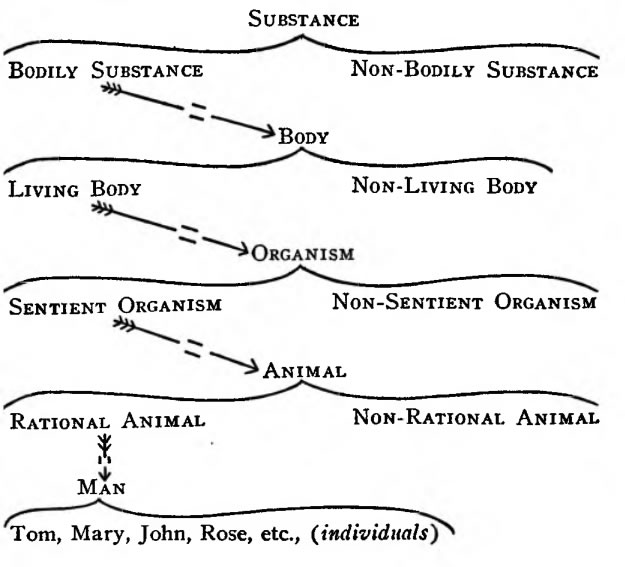
The trunk of the tree (which, by the way, appears to be growing upside down) is a line of genera or generic ideas: substance, body, organism, animal. The branches on either side of the trunk stand for species or specific ideas. Each genus, beginning with substance (which is the supreme genus) is distinguished into two species; each species is constituted by the genus just above it (called the proximate genus in each respective case) plus the specific difference. Thus the species living body is constituted by the proximate genus body, and the specific difference living (being). Each species becomes a genus with respect to its inferiors when viewed in their essential differences, until a species is reached which admits no such differences among its inferiors. Each genus is proximate to the species into which it is immediately distinguished, and remote to the species further down the tree. Thus the genus body is proximate to the species living body and non-living body, but body is the remote genus of animal and man. Conversely, the species man is referred to animal as its proximate genus, and to organism, body, and substance, as its remote genera. Man is the ultimately differentiated species, and cannot be a genus, for its inferiors are not essentially (or specifically) distinguished. We may classify human individuals and list them in groups according to talent, culture, nationality, religion, color, political preferences, and so on, but such classification is never essential; it is non-essential or accidental. A somewhat simpler presentation of “the subordination of genera and species’’ is the following:

This schema shows clearly how each species becomes the proximate genus of its inferiors until the last or ultimate species is reached; this ultimate species applies to (or is predicable of) inferiors which are not essentially (or specifically) distinguished one from another, for all have the same completely rounded essence; these inferiors are distinguished only as individuals, or, to use an ancient technical phrase, “these inferiors are not specifically, but only numerically, distinct.”
d) Transcendental Ideas
An idea is predicable of its inferiors because it represents in the mind (completely, if a species; incompletely, if a genus) the essence which is present in each and every one of its inferiors. An idea (which, as such, is universal) thus applies in a definite field; it is applicable to its own inferiors, and not applicable to the inferiors of a different idea. Thus the idea body, although it is of vast extension and includes as inferiors all corporeal realities, has clear-cut limits by which it is marked off from fields in which it does not apply. It is marked off from the field of nonsubsistent realities and from the field of spiritual substances.
A universal idea is, therefore, held within bounds. It has a determined field of application, a circumscribed group of inferiors. And there are inferiors of other ideas which are not in its field but in their own. Now, a transcendental idea (named from the Latin transcendens, “climbing over,” “crossing over,” “soaring above”) is not thus held within bounds. It climbs over, or soars across, the boundaries that mark off the inferiors of one universal idea from those of another, and applies to all and is predicable of all and even to the marks that distinguish them one from another. The idea being is a transcendental idea. Being means thing. And all that exists or can be thought of as existing; all that can serve to mark off or distinguish one reality from another; all that is existible, whether finite or infinite, created or increate, subsistent or non-subsistent, bodily or non-bodily, living or non-living, actual or merely possible,—all, all without exception, are some sort of thing. Hence all come under the application and predication of the idea being; all are inferiors of the idea being, and there are no inferiors of any other idea to which being does not apply or of which it is not predicable. Even the relations and distinctions that exist among realities are inferiors of being, for these also are things.
The transcendental ideas are being and its (more or less perfect) synonyms: thing, something, reality, entity, not-nothing, the one, the good, the true. That the first five of these ideas are practically synonymous with being is manifest. In a later Book and Chapter we shall see that the remaining three (the one, the good, the true} are also synonyms of being, and hence are truly transcendental ideas.
Summary of the Article
In this Article we have laid the foundation for an adequate grasp of what is to follow. We have defined idea or concept. We have noticed that ideas as such are universal, that is, regarded in themselves, ideas are mental grasps of essences which may be found (or are regarded as though they might be found) in a plurality of things. We have learned what is meant by the inferiors or subjects of an idea, and have seen that an idea, in itself universal, may be applied to its inferiors (or predicated of its subjects) as universal, indefinite, particular, or singular. We have seen that the most important classification of ideas and of their inferiors are genera and species. We have indicated the meaning of the transcendental idea.